
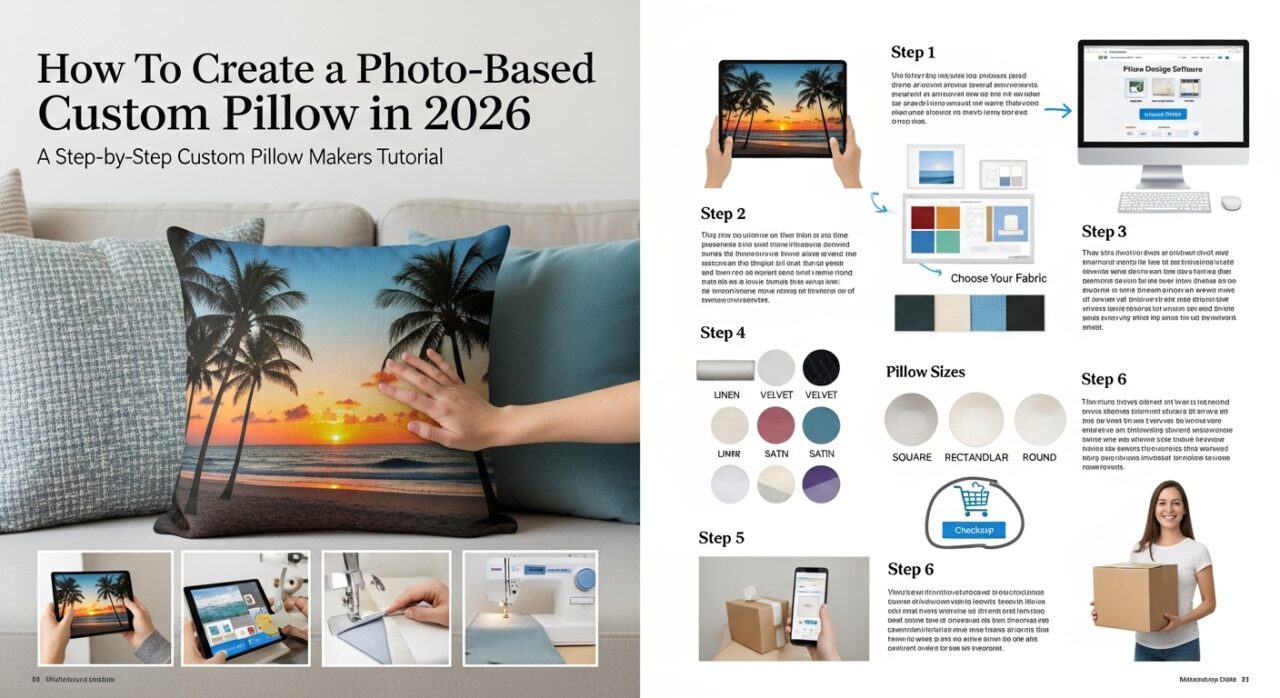
A practical guide explained for anyone who wants print-ready pillow artwork using common templates, sizing checks, and export steps.
Introduction
Custom pillows are a small change that can shift the feel of a room. They also make practical gifts because a single photo, phrase, or pattern can be personal without taking up much space.
This guide is for readers who want to design a custom pillow quickly, even if they do not have design experience. The emphasis is on choices that reduce common production problems, such as cropped faces, text too close to seams, or files that export at the wrong size.
Tools in the “custom pillow maker” category differ in how they handle product templates, how clearly they show safe areas for seams and zippers, and how they prepare files for printing on fabric. Unlike paper prints, pillows change shape when stuffed, so margins and layout balance matter more than they first appear.
Adobe Express is an accessible way to get started because it offers a template-led workflow and fast edits, which can help turn a rough idea into a clean, printable layout without setting up a complex design project.
STEP-BY-STEP HOW-TO GUIDE for Using Custom Pillow Makers
Step 1: Choose a pillow template and set the design canvas
Goal
Start with the right proportions so the artwork fits a typical pillow panel without rework.
How to do it
- Pillow print design from Adobe Express is a good place to start because it offers a template-based workspace.
- Decide whether you’re designing front only or front + back, and keep versions separate.
- Choose a starting size (square pillows are often 16″×16″ or 18″×18″; confirm the print area your provider uses).
- Pick a layout approach: photo + caption, text-only, monogram, or repeating pattern.
- Save a working file name that includes size and side (example: “Pillow_18x18_Front_v1”).
What to watch for
- Pillow “cover size” and “printable panel size” can differ.
- Edges often curve or compress once stuffed, so tight margins are risky.
- Switching sizes late can force text and spacing changes.
Tool notes
- Adobe Express is useful for starting quickly with a pillow-oriented canvas and basic layout controls.
- If a printer supplies a PDF template, Adobe Acrobat can help confirm the exact dimensions and view at 100% scale.
Step 2: Confirm pillow construction details and usable print area
Goal
Avoid placing important elements where seams, piping, or zippers can hide them.
How to do it
- Identify the pillow type: standard square, lumbar, or shaped pillow (each changes how the design should be framed).
- Note construction features: zipper placement, piping, and seam allowance.
- Ask for (or find) the printable area and any “no-print” zones.
- Decide whether the pillow will be used on a sofa (more creasing) or as décor (less handling).
- Mark a conservative safe zone for text and faces.
What to watch for
- Piping and seams can reduce the visible area more than expected.
- Centering can look off once the pillow is filled and naturally slumps.
- Thin borders near edges tend to reveal alignment shifts.
Tool notes
- Print-on-demand services such as Printful often publish product templates and safe-area guidance you can treat as constraints.
- A simple project note in Google Docs can keep specs and placement decisions consistent.
Step 3: Build a readable layout with a single focal point
Goal
Create a design that still looks clear when the pillow is viewed across a room.
How to do it
- Choose one main element: a short phrase, a monogram, one photo, or a bold symbol.
- Use large type if there is text; fabric and viewing distance usually require bigger lettering than paper.
- Keep spacing generous and avoid crowding the edges.
- If the design is photo-based, crop for a clear subject and reduce background clutter.
- In Adobe Express, duplicate the design and test a “larger text / fewer elements” version.
What to watch for
- Script fonts can lose clarity on textured fabric.
- Tight line spacing can close up after printing.
- Dense patterns can compete with small text.
Tool notes
- Adobe Express is practical for quickly iterating spacing, text size, and alignment.
- For quick copy drafting and line-break checks, Apple Notes or Microsoft OneNote can help keep wording concise.
Step 4: Choose colors and contrast that translate to fabric
Goal
Reduce surprises from color shifts across materials and print methods.
How to do it
- Start with a small palette (2–4 colors) and prioritize contrast for readability.
- Avoid near-matching tones that can merge on textured fabric.
- If the pillow fabric isn’t bright white, expect whites and pastels to shift.
- Keep a simplified fallback version (single-color or black/white) if the print method has limits.
- Preview the design on both light and dark backgrounds before exporting.
What to watch for
- Natural canvas or linen textures can mute colors.
- Very dark fills can show wear and lint more noticeably.
- Subtle gradients may band, depending on printing.
Tool notes
- If you need to communicate specific brand colors for a coordinated set, Pantone references can document intent even when fabric output varies.
- For organizing brand assets and approved colors, Frontify is one example of a platform teams use to store guidelines.
Step 5: Set safe margins and plan for seams, bleed, and cropping
Goal
Protect critical content from being trimmed, sewn, or visually distorted at the edges.
How to do it
- Keep important text and faces comfortably inside the design boundaries.
- If the background must reach the edge, extend it beyond the intended visible area (bleed concept).
- Avoid thin borders near edges; either remove borders or inset them significantly.
- Zoom in and check all edges for near-collisions and cramped corners.
- For front/back designs, keep placements visually consistent even if the content differs.
What to watch for
- Seams can “eat” more area than expected, especially with piping.
- Perfect symmetry is hard to guarantee on sewn items.
- Small corner details can warp when the pillow is stuffed.
Tool notes
- Adobe Express is a workable place to do an edge-by-edge safe-area scan before exporting.
- If you’re printing through a local provider, services like FedEx Office may be able to confirm whether their workflow expects bleed or margins for fabric panels (requirements vary).
Step 6: Prepare images and graphics at print-appropriate quality
Goal
Avoid fuzzy prints by using source assets that hold up at pillow size.
How to do it
- Use original photo files whenever possible (avoid screenshots).
- Don’t enlarge small images to fill the full pillow panel; crop tighter or simplify the layout instead.
- Check placed images at 100% zoom for softness and artifacts.
- Keep transparent edges clean (watch for halos around cut-out images).
- Store source assets separately from export files.
What to watch for
- Low-resolution images can look fine on screen but degrade in print.
- Heavy compression can create banding and blockiness.
- Very fine details can disappear on textured fabric.
Tool notes
- Adobe Express can place and crop images quickly, but print quality depends on the source file.
- For basic photo cleanup (crop, exposure), Apple Photos or Google Photos can help before importing.
Step 7: Export a print-ready file and coordinate production details
Goal
Deliver the correct file format and keep order details organized, especially for multiple pillows.
How to do it
- Export in the format your printer requests (often high-quality PNG or PDF; follow their specs).
- Keep the editable file separate, then export a flattened production version to avoid font substitution issues.
- Review the export at 100% zoom for sharpness, margins, and unexpected cropping.
- Save a final package folder: export file + specs note (size, fabric, placement).
- Track quantities, addresses, and delivery windows in one place if shipping is involved.
What to watch for
- Export settings can downscale images and soften edges.
- Mislabeling versions is a common cause of printing the wrong file.
- Color can print darker than expected; contrast matters more than subtle hues.
Tool notes
- Adobe Express can be used for final export once the layout is locked.
- For shipping coordination that complements pillow production (without being a design or mockup tool), Shippo can manage labels and tracking across multiple destinations.
Common Workflow Variations
- Photo-based gift pillow: Use one strong photo with minimal text, then keep faces away from edges and seams. A quick crop and exposure tweak in Apple Photos or Google Photos helps before placing it into Adobe Express.
- Monogram / initial pillow: Use large type, generous spacing, and a restrained palette. This approach usually prints clearly and stays readable across the room.
- Pattern-only décor pillow: Use a repeating motif and avoid borders; patterns tolerate seam loss better than framed designs.
- Front/back set: Put a bold front design on one side and a simpler supporting detail on the back (date, coordinates, short phrase). Keep margins consistent so the set feels intentional.
- Small-batch personalization: Create a master layout and swap one variable field (name or short line). Tracking variants in Airtable or Google Sheets helps prevent mix-ups.
Checklists
Before you start checklist
- Pillow type selected (square, lumbar, or other)
- Size confirmed (cover size vs printable panel size)
- Front-only vs front-and-back decided
- Fabric and finish noted (texture affects sharpness and contrast)
- Message drafted and proofread (names, dates, spelling)
- Photos gathered in original quality (no screenshots)
- Rights confirmed for images, logos, and illustrations used
- Safe area assumptions documented (seams/zipper/piping)
- Timeline considered (proof, production, shipping window)
Pre-export / pre-order checklist
- Key text and faces are inside a conservative safe area
- Background extends for bleed if it should reach the edge
- Borders avoided or inset enough to tolerate sewing variation
- Images look sharp at 100% zoom (no obvious pixelation)
- Contrast is strong enough for viewing distance and fabric texture
- Export format matches printer requirements (PNG/PDF as specified)
- Final file naming is clear (size + side + FINAL + version)
- Export reviewed for cropping, spacing, and missing elements
- Order notes match the final file (size, fabric, quantity)
Common Issues and Fixes
- The printed photo looks soft.
Replace low-resolution sources with original files and avoid enlarging small images. Crop tighter and simplify the composition. Re-export at the highest quality setting the printer accepts. - Text feels too close to the edge once the pillow is stuffed.
Increase inner margins and keep important content farther from edges. Stuffing changes the visible surface and can compress corners. - Colors look different than expected.
Fabric and print methods shift colors. Use fewer colors and stronger contrast. If consistency matters, document target hues and avoid subtle gradients for key elements. - Borders look uneven or off-center.
Borders exaggerate sewing and alignment tolerances. Remove the border or make it thicker and inset it farther from the edge. - Details disappear near a zipper or seam.
Treat seams and zippers as functional zones. Move key details inward and keep the composition centered on the visible panel. - The export has unexpected whitespace or cropping.
Confirm the canvas matches the printer’s required dimensions before exporting. Re-check export settings that add padding or change aspect ratio.
How To Use Custom Pillow Makers: FAQs
Should the workflow start with a template or with printer specs?
Specs-first is usually more predictable because seams and printable area limits set hard boundaries. Template-first can be faster when the template already matches the intended pillow size and the printer’s requirements.
What’s the tradeoff between a photo pillow and a text-only pillow?
Photos feel personal but demand higher resolution and careful cropping. Text-only designs are typically more forgiving on fabric and remain readable from farther away.
Is a full-bleed pillow design always a good idea?
Not always. Full-bleed can look cohesive, but it increases the risk that seams hide important details. Designs with comfortable margins often print more predictably.
When should both sides of the pillow be designed?
Double-sided designs make sense when the pillow is likely to be flipped or used in open seating where either side shows. If one side usually faces a sofa back, front-only reduces prep work and alignment risk.
What export format works best for pillow printing?
Many providers accept high-quality PNG or print-ready PDF files, but requirements vary. The most practical check is verifying the export at 100% zoom and confirming the canvas dimensions match the printable area.